Series. Overview · 1. File · 2. Profile · 3. Projects · Choosing · 4. Matches
An Ancestor Project is a group of people on GEDmatch linked by a surname, a family, a village, a geographic region, a historical territory or one family line. They want to work that link together, not browse the whole site one by one.
The name of the feature on the site is Ancestor Projects. These are not Ancestry.com projects. The mix-up is common, and it sends people to the wrong place.
Why a project, when there are already thousands of matches
Suppose you have 20,000 potential DNA matches. That is a huge list. What you care about is one line: a great-grandfather, Pinsk district, the nineteenth century.
If an Ancestor Project has gathered people who themselves claimed a link to that surname or that region, you get a much more interesting sample. GEDmatch lets you use a project as a subset of your matches and look for segments among the members. That is how the work is set up in the site’s material on searching for segments.
all matches on GEDmatch
        ↓
Ancestor Project
        ↓
people with the family or geographic link you need
        ↓
shared segments
        ↓
a hypothesis about a shared ancestor
That is the practical value of projects. Not that “you were accepted into a group”, but that a long list narrows to people who have already named the same region or the same surname.
A whole pedigree does not go into one project. What goes into each project is the ancestor of that project.
How to find the project you need
For project Belarus the path on the site is Home → Free Tools → Ancestor Projects. On the page that opens, choose the Search Projects tab and type Belarus in the Search field. In the project row, press the green JOIN button.
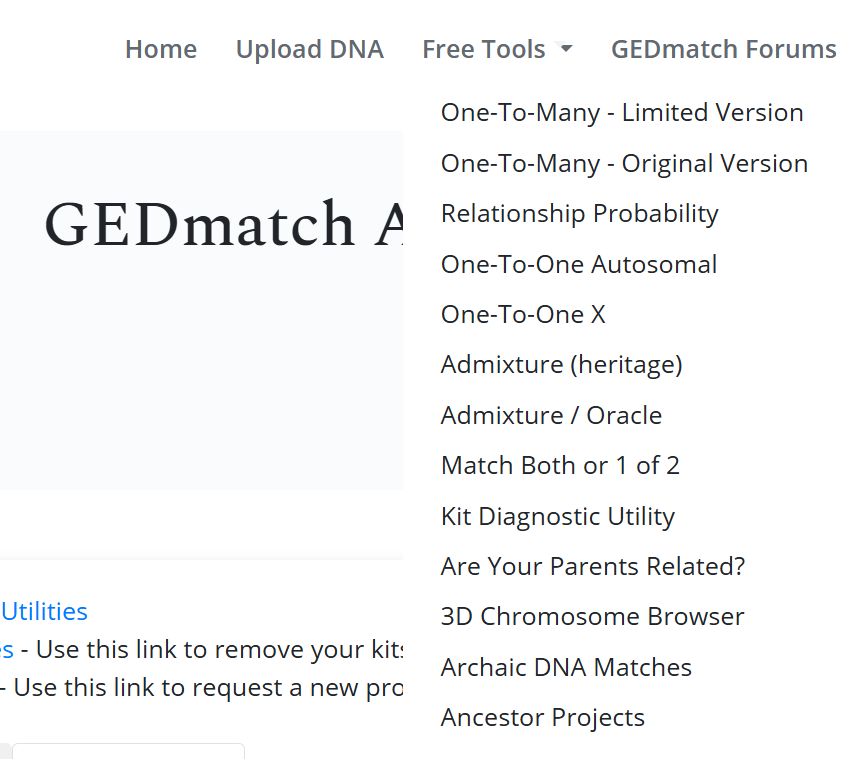
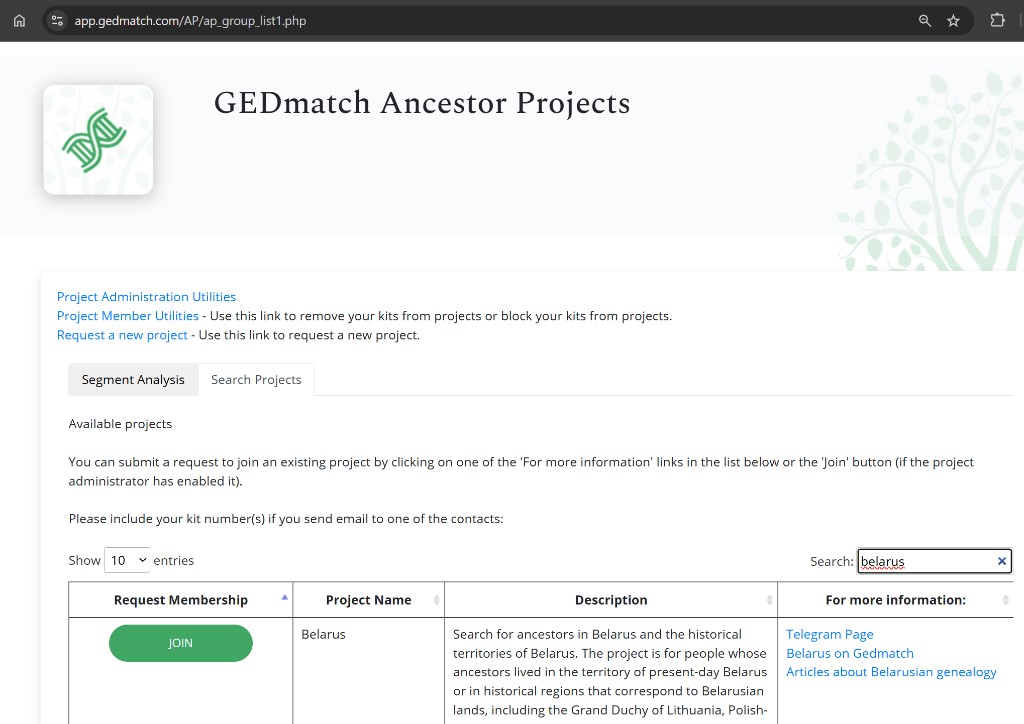
If you arrived by a direct link, search for the exact name written in it. That is faster than trying neighbouring groups at random.
Do not search only by the modern country. If the ancestors lived on Belarusian lands, it is worth trying different words, because projects are opened on different principles: by country, by governorate, by locality, by surname, by one branch.
Belarus Belarusian Minsk Polesie Pinsk Vitebsk Vilna Lithuania Poland
Historical borders moved. The project you need may not be named like the modern region in a passport. When there are several projects, which one to join now and which to leave wide: how to choose an Ancestor Project.
Find the project and press Join. An administrator confirms the application, not a robot. Look for the letter in the inbox and in spam. If the join button is not on the row, the project card usually says how to write to the administrator: email, a site or a group. Column labels on the site change; the point stays.
In the application, mark the number of the kit that belongs to the project. If the account holds several people, do not tick all of them in a row. The administrator should see one person and one line, not the whole family in a heap.
What to write in the application
The most important part starts after Join. A form opens. Fill it with your own data in English or Latin script, as in fig. 3: in the first field, the ancestor, an approximate date and the place; in the second, other projects and forums if you belong to them; below, tick the kit of the line that belongs to the project. Cyrillic in these fields reaches the administrator as question marks.
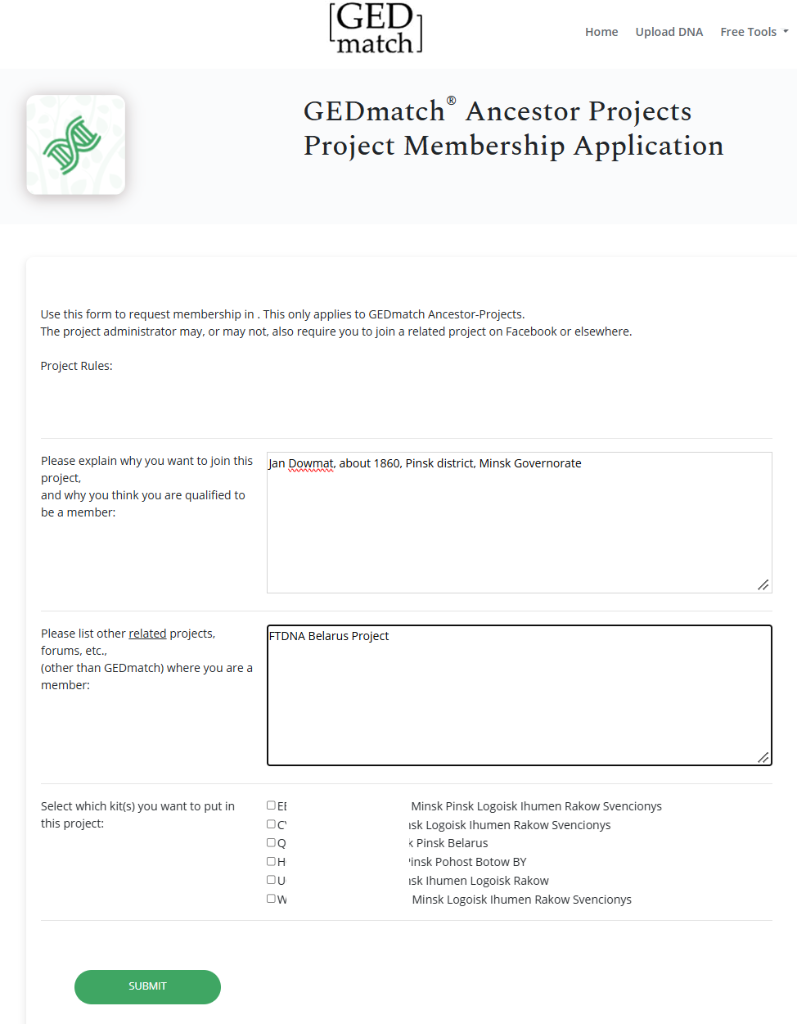
The administrator needs to see which line of your ancestors belongs to the project.
A poor version:
My ancestors were from Belarus.
Worse:
I am looking for relatives.
“Belarus”, “Poland”, “looking for relatives” gives the administrator nothing to place on a branch. He cannot tell which ancestor you are bringing into the project.
A good version names the person, an approximate date, the place and the surnames of that line, and also says whose kit it is:
Father's line.

Ivan Ivanov, born around 1860,
Such-and-such village, Such-and-such parish,
Pinsk district, Minsk Governorate.

Surnames on this line:
Ivanov, Petrov, Petrashkevich / Pietraszkiewicz.

This GEDmatch kit belongs to me.
My father has not been DNA tested.
Kit: AB1234567
In a join request write only in English or in Latin script, because Cyrillic reaches the administrator as question marks.
Better not to copy the same paragraph into every project. If you join a surname project, write about the surname. If it is a regional project, write about the region and about the line that belongs to it. If it is a project of one family branch, write about that branch. One text “about the whole pedigree” in every application is something the administrator cannot sort out.
If a parent tested
This is a very useful situation, and it is often missed.
You are working the ancestors from Pinsk district on your father’s side. Your father also took a DNA test. For a project devoted to the paternal line, his kit is more informative than yours: your DNA is a mixture of the paternal and maternal sides. A parent’s kit is more useful for a geographic project. Join with his number and say so plainly.
If your father has not tested, join with your own kit and say so in the application, as in the template above. The administrator will not then wait for a second number. A child’s kit can be added as a second line, with a note of whose it is.
If several relatives tested
Suppose GEDmatch has you, your father, an aunt and a cousin. You can now ask not only “who matches me” but also “who matches me and my father” or “who matches me and my aunt”.
Several known relatives from the same cluster are stronger than one long list. If a brother, an aunt or a cousin has already tested, have them upload the file in the same order and join with their own number. Two kits with a paper relationship you already know let you separate a shared segment of the line from a chance one.
How to read those matches afterwards is covered in the next article.
Why this shows so clearly on Belarusian lands
The same ancestor could have lived in the Grand Duchy of Lithuania, in the Polish-Lithuanian Commonwealth, in the Russian Empire, in interwar Poland, in the BSSR and in present-day Belarus. Today he is searched for as Belarusian, and the parish record sits in a fond a modern researcher will open as Lithuania, Poland or Ukraine.
That is why I am building Ancestor Project Belarus. The idea is to gather people whose ancestors are tied to the territory of present-day Belarus, look at shared segments inside that group, and then lay them next to surnames, villages and archival documents. For me the value of the project is not the number of members. It is that a geographic group becomes a working sample, not one more general list.
A short preparation of a kit for an application to this project: 15 minutes.